
Engineered Not Generated — The Founding Manifesto
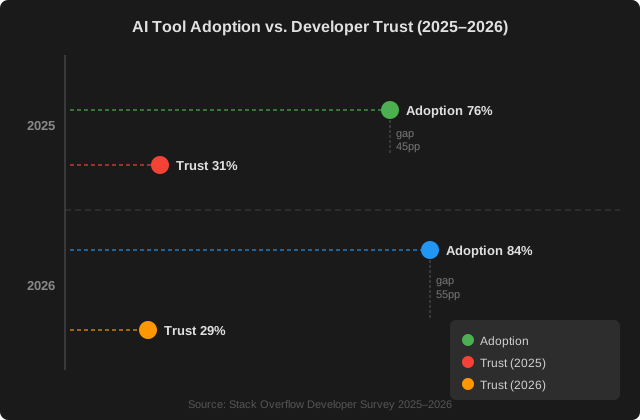
In 2026, 72% of developers use AI tools daily, but only 29% trust their output. AI makes code cheap. Engineering makes it trustworthy.
Introduction
In 2026, we find ourselves in a paradox: never before has writing code been so fast, yet never before has writing good code felt so urgent.
AI tools generate code at unprecedented speed. But generated code is not engineered software. It may work in a demo. It may satisfy a prompt. But it may also fail in production, degrade over time, or make future changes harder.
This manifesto is for software engineers, tech leads, and architects who use AI daily but worry about code quality, architecture coherence, and long-term maintainability. It is for those who ask: How do I use AI without abandoning engineering discipline?
We believe:
AI makes code cheap. Engineering makes it trustworthy.
This essay defines what Engineered Not Generated stands for, why the distinction between generated and engineered software matters more than ever, and what kind of thinking this site will consistently bring.
Key Takeaways - In 2026, 72% of developers use AI tools daily, but only 29% trust their output (Stack Overflow, 2025). AI makes writing code easy, but only engineers can build systems that survive change. - Generated is not engineered. Prompts are not requirements. Working code is not the finish line. - AI is leverage, not replacement — engineering judgment is the most valuable skill in 2026.\n
Why "Generated" Is Not "Engineered"
In 2026, 59% of developers report using three or more AI coding tools every week (Netcorp, AI-Generated Code Statistics 2026). The tools are fast, convenient, and ubiquitous. But generated code is not engineered software.
Generated means produced by an algorithm in response to a prompt. It is code that exists, compiles, or even passes tests. It may solve the immediate task, but it lacks the intentionality, foresight, and trade-off awareness that define engineered systems.
Engineered means designed to satisfy not just a prompt, but requirements, constraints, users, teams, and future maintainers. It is code that is reviewed, tested, documented, and structured for long-term evolution. It is built with judgment, not just speed.
This distinction is not theoretical. We’ve seen AI-generated features released to production that passed all local tests but later crashed under real-world load. The code worked — but it was not engineered for the realities of scale, concurrency, or fault tolerance.
 Generated code vs. engineered systems: one is syntax, the other is structure.
More Code Is Not Better Software
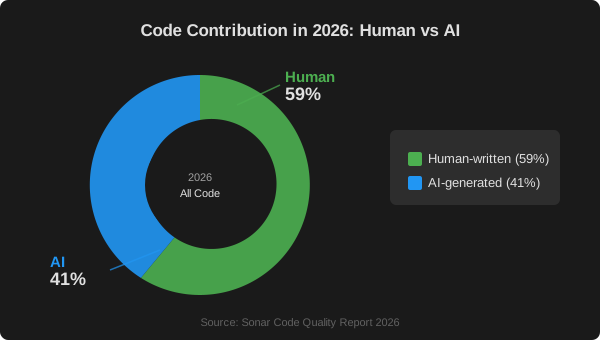
In 2025, AI-generated code contributed to a 4x increase in duplicate code blocks and short-term churn, according to GitClear’s research (GitClear, AI Copilot Code Quality 2025). By 2026, 41% of all code written is AI-generated (First Line Software, 2026).
More code does not mean better software. It often means more surface area for bugs, more friction for refactoring, and more cognitive load for teams. AI tools excel at generating volume, but volume is not a measure of quality, maintainability, or design coherence.
The danger is not that AI writes bad code — it’s that AI writes all the code, including the parts that weren’t needed, the redundant logic, and the quick fixes that spiral into technical debt. Engineering discipline is what prevents codebases from becoming unmanageable.
Our finding: Teams that measure lines of code added see AI as a productivity win. Teams that measure time to understand the codebase or time to safely refactor see a different picture.
→ AI Makes Code Cheap. Engineering Makes It Trustworthy.
Prompts Are Not Requirements
Only 1 in 4 AI-generated features fully meets the implicit requirements of maintainability, security, and scalability (DORA State of AI-assisted Software Development 2025).
Prompts are not requirements. A prompt is a few lines of text describing a desired outcome in developer terms. But requirements aren’t just about what the code should do — they’re about what the code must survive.
Requirements cover:
- User needs — Does this solve a real problem?
- Business context — How does this fit into our strategy?
- Technical constraints — Latency, throughput, error handling, observability.
- Evolvability — Will this be easy to change in 6 months?
- Maintainability — Will a teammate understand this in 12 months?
AI tools don’t ask these questions. They generate code that works, not code that lasts.
Consider a recent incident analyzed by Keyhole Software (Keyhole, AI Software Development Costs 2026): an AI-generated micro-service worked perfectly in development but lacked proper circuit-breaking logic. Under production load, it cascaded into a full outage. The feature met the prompt — but not the real requirements.
Rewriting a prompt won’t fix this. Engineering judgment will.
AI Makes Code Cheap. Engineering Makes It Trustworthy
In 2026, 72% of developers use AI tools daily, but only 29% trust their output (Stack Overflow Developer Survey 2025).
AI makes writing code cheap. But trustworthy software is not cheap — it’s valuable. And value comes from engineering.
Engineering is the multiplier. It turns code into systems that are:
- Verifiable — You can prove it works, not just hope.
- Maintainable — Future teams can evolve it without fear.
- Architected — Components are organized, reusable, and loosely coupled.
- Performant — It meets SLAs under load.
- Secure — Defenses are built-in, not bolted on.
The trust equation: Trust = code + review + tests + design + judgment.
AI tools can contribute to the first two terms (code and review), but they cannot replace the others. Engineering is what transforms generated output into trusted systems.
 Engineering discipline turns generated code into trusted software.
Working Code Is Not the Finish Line
AI-generated code often passes local tests, but the majority of production incidents linked to AI-generated features involve unforeseen interactions — edge cases, race conditions, integration failures (Coderabbit AI, 2025).
For AI, "working code" is the starting line, not the finish.
The real finish line includes:
- Documentation — How it works, why it works, and how to extend it.
- Observability — Metrics, logs, traces.
- Test Coverage — Unit, integration, and system tests.
- Design Review — Architecture fit, consistency, scalability.
- Peer Review — A second pair of eyes.
Working code is the minimum. Engineered software is the standard.
Engineering Judgment Is the Most Valuable Skill in 2026
When AI writes almost all code, engineering judgment becomes a scarce resource (Pranav Khodanpur, 2025).
Judgment isn’t about syntax or speed — it’s about knowing what to build, how to build it, and, crucially, what not to build.
What judgment means in 2026:
- What to build — Is this feature valuable, or just feasible?
- How to build it — What design minimizes regret?
- When to use AI — AI excels at repetitive tasks; humans excel at strategic decisions.
- When not to use AI — For architecture, design, or requirements, human judgment is non-negotiable.
- Trade-offs — Performance vs. cost, speed vs. safety, flexibility vs. simplicity.
Developing judgment requires:
- Studying design: Read patterns, anti-patterns, and architecture books.
- Working on legacy systems: Understand why code lives for decades.
- Reviewing AI output critically: Treat AI as a junior dev — review, guide, and correct.
AI is a bicycle for the mind — but someone still has to steer.
The Future Is AI-Assisted, Not Engineering-Free
By 2026, AI-related IT spending will reach $1.2 trillion, and engineering roles are evolving — not disappearing (Gartner, 2026).
The future is AI-assisted, not engineering-free. AI handles the repetitive, the predictable, the templated. Engineers handle the strategic, the architectural, and the judgment-heavy.
The new division of labor:
- AI writes — boilerplate, tests, refactoring, documentation.
- Engineers guide — design, requirements, review, trade-offs, architecture.
AI is leverage. Engineering is judgment. The best teams use AI to amplify human expertise, not replace it.
Headcount shift: Teams at top tech companies now hire fewer mid-level coders and more staff engineers. The value is no longer in writing code — it’s in designing systems.
Join the Manifesto
This manifesto is the foundation of Engineered Not Generated — a community for software professionals who use AI as a tool, not a crutch.
We believe:
- AI makes code cheap. Engineering makes it trustworthy.
- Prompts are not requirements.
- Working code is not the finish line.
- The future needs more engineers, not fewer.
What’s next?
This is Pillar 1 — Foundations Revisited. In the coming weeks, we’ll explore:
- How to refactor AI-generated code into maintainable designs.
- Why software design still matters when AI writes code.
- Testing strategies for AI-assisted development.
- How technical debt grows at AI speed.
Join the conversation. Push back. Build with us.
FAQ
What does "Engineered Not Generated" mean?
In 2026, Engineered Not Generated means recognizing that while AI tools can quickly produce code, only human engineering can turn that code into trusted, maintainable, and evolvable systems. It’s a call to apply classic software engineering principles — design, review, testing, and judgment — to AI-assisted development.
Is this site anti-AI?
No. We embrace AI as a powerful tool. What we oppose is the shallow belief that AI-generated code is sufficient — that the job is done once the code compiles. Good software requires more than generation; it requires engineering.
How can I apply engineering discipline to AI-generated code?
Start with this checklist:
- Review every AI-generated output as if it came from a junior developer.
- Ask: Does this fit our architecture? Can a teammate understand it?
- Add robust testing, observability, and documentation.
- Measure maintainability, not just speed.
Conclusion
The rise of AI doesn’t diminish the need for engineering — it amplifies it.
AI makes code cheap. Engineering makes it trustworthy. Prompts are not requirements. Working code is not the finish line. The most valuable skill in 2026 is not writing code; it’s crafting systems that endure.
The future is not engineering-free. It is AI-assisted, with judgment leading the way.